
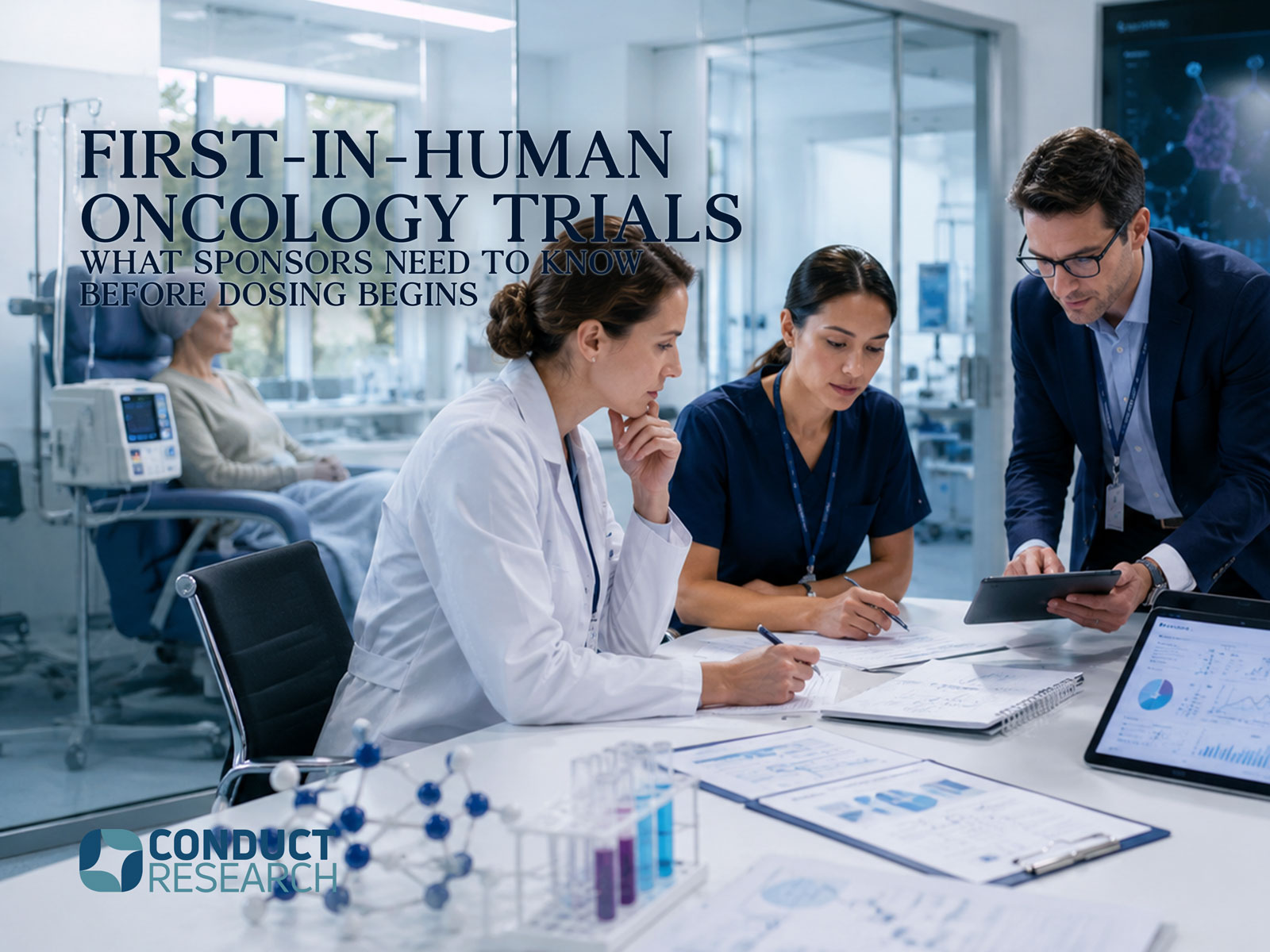
First-in-Human (FIH) clinical trials represent the most pivotal — and most scrutinized — moment in pharmaceutical development. For oncology sponsors, the stakes are even higher: patients enrolling in FIH cancer studies often have exhausted other treatment options, making the responsibility for safety and scientific rigor particularly profound. Understanding what it takes to execute an oncology FIH trial successfully can help sponsors make informed decisions about CRO selection, trial design, and regulatory strategy.
What Is a First-in-Human Trial?
A First-in-Human (FIH) trial is the initial administration of an investigational drug or biologic to human subjects. These Phase I studies primary objective is to evaluate safety and tolerability, establish pharmacokinetics (PK) and pharmacodynamics (PD) profiles, and identify a maximum tolerated dose (MTD) or recommended Phase II dose (RP2D). In oncology, FIH trials frequently recruit patients with advanced malignancies who have progressed on all available therapies.
Dose Escalation Design: Choosing the Right Model
The dose escalation strategy is the scientific heart of an FIH trial. Traditional 3+3 designs offer simplicity and regulatory familiarity, while model-based approaches like the Bayesian Optimal Interval (BOIN) design and modified Toxicity Probability Interval (mTPI) offer greater flexibility and statistical efficiency. For oncology FIH studies where dose-limiting toxicities (DLTs) are common, model-based designs increasingly represent the standard of care in clinical trial methodology.
Regulatory Considerations for Oncology FIH Studies
Oncology FIH trials must address specific regulatory requirements, including thorough characterization of the non-clinical safety package, a comprehensive Investigator’s Brochure, and a detailed clinical development plan. Health Canada, FDA, and EMA each have published guidance documents specific to FIH trials that inform protocol design and regulatory submission strategy. Conduct Research’s regulatory team is experienced in navigating these jurisdiction-specific requirements.
Safety Monitoring: The DSMB and Beyond
Robust safety monitoring is non-negotiable in FIH trials. Data Safety Monitoring Boards (DSMBs) provide independent oversight of accumulating safety data. At Conduct Research, we coordinate DSMB establishment and liaison, develop safety monitoring plans, and implement real-time adverse event tracking systems that enable rapid response to emerging safety signals.
Patient Selection and Enrollment in Oncology FIH Trials
Eligibility criteria for oncology FIH trials must balance scientific rigor with practical enrollment feasibility. Criteria that are too narrow can make enrollment targets impossible to achieve; criteria too broad introduce safety and data interpretation challenges. Our team works with sponsors to develop eligibility criteria that are scientifically appropriate, operationally feasible, and aligned with regulatory expectations.
Conclusion
A First-in-Human oncology trial is the beginning of a drug’s journey toward potentially transforming patient care. Executing it with precision, regulatory fluency, and deep oncology expertise ensures that this crucial first step leads to the meaningful results that justify the next phase of development. Conduct Research brings all of these capabilities — and more — to every FIH trial we support.
